
I sat down with Brian Prendergast, Director of Maryland's Mosquito Control Program, for an interview about how the program works. Please note that I have merely published Brian's responses, and have not made any attempt to make any commentary on the Maryland Mosquito Control Program itself or Brian's responses. I sent Brian the exact text published here for approval prior to posting it to ensure his views and statements were accurately conveyed.
1.) First, can you just give us a broad overview of
Maryland’s Mosquito Control Program and the different components of it? It’s
more than just the truck-based spraying right?
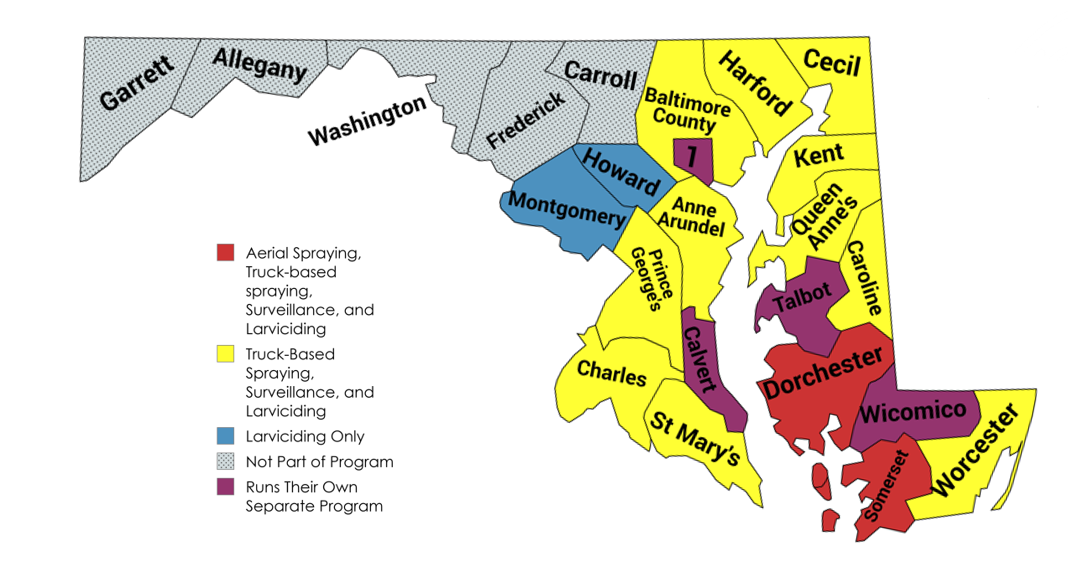
Maryland’s Mosquito Control Program is one of very few on the East coast that operates at the state level rather than at the County level, which is more typical. MDA has agreements with 15 Maryland counties to perform some type of Mosquito Control. 5 counties, those in Western MD, used to be part of the program but stopped due to the expense. The remaining 3 counties, plus Baltimore city, run their own programs separately.
The counties participating must pay for approximately 63% of the cost, with MDA
picking up the rest. Of the 15, 13 have truck-based, ULV adulticide spraying,
with Montgomery and Howard being the two that do not. Contrary to popular
belief, Montgomery and Howard do participate in the program, but only the
larviciding portion. Only Dorchester and Somerset receive aerial adulticide
spraying, which is targeted at salt marsh mosquitos. In the counties receiving
adulticide spraying, truck-based or aerial, the decision of whether to spray on
a given day or week is based on an action threshold.
2.) What are the action thresholds that are used?
There are two measurements used to determine whether spraying should occur. The first uses surveillance traps. In Anne Arundel, approximately 50 trap-nights are deployed per week. A “trap-night” in this case is the number of traps multiplied by the number of nights. For example if 10 traps are deployed for 5 nights, that would be 50 trap-nights. Traps can be moved to different locations between nights. The action threshold, for truck-based spraying, is 24 female mosquitos per trap per night. This would not be averaged across trap locations.
However, even if this is not met, spraying
can occur if another action threshold is met. When the trucks drive around, the
applicator conducts a landing rate count measurement to determine the biting
pressure in the local area. Essentially, the applicator uses themselves as bait
for mosquitos and counts how many land. This can be a better indication of the
population size of a species that may not be as attracted to the surveillance
traps, which are typically CDC light traps. The threshold used is 3 mosquitos
per 2 minutes for truck-based spraying and 12 mosquitos per minute for aerial
spraying. Typically landing rate counts are done between 1 hour before dusk and
2 AM, which is when truck-based spraying occurs.
3.) Given that Tiger mosquitos, Aedes albopictus, are known to not be particularly attracted to CDC light traps and also would be less active after dusk for a landing rate count, wouldn’t they not be well accounted for with these action thresholds?
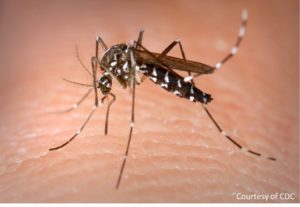
It is true that the tiger mosquitos wouldn’t be
caught with CDC light traps or a landing rate count at night. The truck-based
ULV spraying isn’t very effective against that species. It is more effective
against other species, like Culex species, which carry West Nile. The Program
emphasizes telling people they really need to focus on dumping out standing
water in their yards for tiger mosquitos. They don’t have a very far flight
range, so they’re coming from standing water close by. It’s usually tiger mosquitos
when people call and say they have a lot of mosquitos and it’s during the day.
They say they don’t have standing water to dump out and then you go out there
and they do. If people can eliminate standing water or use mosquito dunks that
helps a lot.
4.) What can you tell me about the arbovirus
surveillance work done by Maryland’s Mosquito Control Program?
Despite West Nile being widespread, federal funding for combatting it went away years ago. The Program uses specialized traps for surveillance of arboviruses, viruses that are vectored by mosquitos. Arbovirus surveillance is performed in 11 counties. Montgomery, Howard, St. Mary’s, and Charles Counties have not agreed to partner with MDA for arbovirus surveillance in their Counties. It is unclear why they have not.
The two primary arboviruses
that are tested for are West Nile Virus(WNV) and Eastern Equine Encephalitis(EEE).
The traps are gravid traps that are catching female mosquitos that are laying
eggs, which means they have already taken a blood meal and could have
contracted an arbovirus. Mosquitos are enzootic vectors, acquiring the virus
from another animal during one blood meal and then transmitting the virus to
humans in subsequent blood meals.
The female mosquitos captured by the traps
are grouped into pools and sent to a state lab for testing. One positive test
is not enough, it requires at least 2 positive pools, mostly due to funding
limitations. After a second positive test (for West Nile), adulticide spraying
and larviciding are conducted in a 3/4 mile radius from the trap. The goal is
to eliminate any mosquitos that may have West Nile. This is also done in a 3/4
mile radius around the home of any patient that tests positive for West Nile.
In 2024, there were 14 confirmed cases in Maryland. Arbovirus surveillance
results were also high in 2024. 2024 saw a higher number of cases than 2023,
but was lower than 2012, 2015, and 2018. The primary vectors of WNV in Maryland
are considered to be Culex pipiens and Culex restuans.
5.) What about EEE? Culiseta melanura, the primary vector, requires a very specific habitat. Are there specific locations within the state known to be ideal habitat?
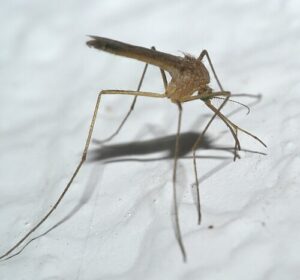
EEE is very focal, and in Maryland there are two
known foci. Culiseta melanura requires acidic swamps with trees growing in the
swampy water. The primary one would be the swamps along the Pocomoke River,
primarily in Somerset County. The second is the Patuxent Wildlife Refuge, but
there haven’t been recent positives from there. Testing is still done there,
due to historical results. If there is a positive pool for EEE, aerial spraying
of an adulticide is used because an immediate impact is needed.
6.) What can you tell me about the larviciding
efforts of Maryland’s Mosquito Control Program?
All 15 counties that participate in the program have a larviciding crew, including Montgomery and Howard, both of which only receive the larviciding. Both BTI and Methoprene are used. Methoprene is preferred by the Program where possible, due to the longer acting 150 day product being available. Labor is the primary barrier due to cost, so the 150 day product is more cost effective. Which is important, because the budget is tight. In some cases BTI is used instead, especially when a longer acting product would get washed out or the body of water would dry up. Some areas are treated just once with a 150 day product, while others are treated every time it rains.
Areas for
larviciding are tracked and mapped, and the maps are used to ensure hot spots
are checked and treated. The larviciding is meant to target nuisance species
like salt marsh and floodwater species. There are several species, but the
primary salt marsh species would be Aedes sollicitans and the primary
floodwater species would be Aedes vexans. Sometimes storm sewers are treated if
reducing WNV is the main purpose. The larviciding crews rely heavily on
seasonal summer employees.
7.) Much to do has been made about two “up and coming” species primed for expansion in Maryland, Aedes japonicus (Japanese rock pool mosquito) and Aedes aegypti (yellow fever mosquito). Have you seen growing populations of these species?
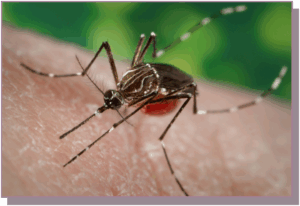
Aedes aegypti adult female. Note the lyre shaped white markings on the scutellum. Aedes albopictus has just a vertical white stripe
Aedes japonicus is seen fairly frequently in
Maryland. It’s been in Maryland roughly 10-20 years, and in North America for
at least 25 years. It is fairly steady state in Maryland and is probably
already living everywhere it will be able to in Maryland. Each species has its
own ecological niche and Aedes japonicus probably already has reached
everywhere within its niche.
Aedes aegypti has had a healthy population in
Washington DC for a while. It’s been there at least 20 years and is growing.
Generally only 1-2 per year are seen in Maryland, near DC. These have usually
been seen as escapes from DC rather than evidence of breeding in Maryland. It
is also sometimes seen in Fairfax County, Virginia. A year or two ago, a more
serious look at this species began. It is definitely on the radar, but no
evidence of breeding in Maryland has been found, despite looking for it near
areas they have been seen. It may have been out competed by Aedes albopictus.
It is possible its historical range extended much further North, potentially as
far as Philadelphia, before possibly being out competed by Aedes albopictus. In
DC it is thought to survive the winter underground.
8.) Does Maryland’s Mosquito Control Program publish
its surveillance data anywhere?
The data is not published. It is stored in a
computer database and can be accessed by the Program’s employees. The data
points they look at most are Culex populations and WNV morbidity in humans. A
possible link between May temps and WNV morbidity has been noted, but requires
further evaluation. WNV also seems lower in Howard County specifically.